
Praised for Potential
There’s a particular kind of torment to being told you’re capable of more. What do I mean by this?
It’s being told you’re a bright spark, or generally more accomplished than average, yet you’re performing below par, below expectation. So, it’s a bit like a backhanded compliment.
Thanks, now what do you expect me to do with this pointless observation?
Possibly the most painful thing about living with ADHD is knowing just how capable you can be, but witnessing your brain refuse to comply and then being perceived as lazy or showing a lack of effort. Some days, you’re on it, harnessing that hyperfocus power for good, or being super organised and getting things done. Other days, you’re a shell of that person; that person is MIA. You have the evidence that you can do these things, so every time you can’t, it feels like a choice. And that hurts. Even more so when you visibly witness the disappointment in your loved ones’ eyes because of it.
‘She is a very capable and intelligent girl, if only she could apply herself more in her lessons and school work.’
It was common during my school years to bring home reports on this theme. Literally, every. single. term. Or however often reports came out back then. Variations on this phrase became inevitable throughout my school years, to the point that it felt like a part of me. A personality feature. I didn’t know how to perform any differently, or not consciously, anyway. By high school, it became clear that I could perform better in some subjects than others, although I’d still succumb to distractions and ultimately receive similar feedback.
Being told by multiple people that I wasn’t working to my potential was disheartening to say the least. It brought on a confusing mixture of pride at receiving recognition for my intelligence and shame and frustration at not being able to tap into it effectively. I actually knew I was capable, but I didn’t know how to be more consistent, which is what it boiled down to.
Take science lessons at high school; practical work like experiments was fun and exciting, because it usually meant a break from the norm of sitting and listening, but writing them up? Bor-ing-hell. Perhaps this is surprising, given my interest in writing, but there’s little creativity to be injected into writing up a report on how yeast enzymes break down hydrogen peroxide. And I’d always forget what order the damn headings went in. Who gives a crap about yeast enzymes? Needless to say, I was often moved to different seats in my science lessons. And rarely had a clue what was being said when singled out to answer a question. I’d be pretty pleased with my doodle, though.
As with any kid, some subjects were more interesting than others, and I usually found the boring ones were where I’d be the most distracted. At home, I’d put things off like homework and tidying my room, typical teenage things, really, but where most might think ‘I can’t be bothered’, for me it was more like ‘I know I should, and I want to get it done, but I can’t seem to make myself’. The difference, I suppose, is the sense of guilt. I don’t think a day has gone by in my living memory where I haven’t felt guilt for something or other.
I think it became an insecurity for me from these difficulties in school that I could be perceived as being dumb. Because I knew I wasn’t. I worried I’d be easily misconstrued as a bit thick by family and peers because I needed things repeated often or didn’t quite grasp something the first time, due to my wandering thoughts. Internally, I had endless curiosity, a genuine thirst for knowledge, and many, many thoughts tumbling around, but because that was often where I resided, I grew embarrassed and prickly about being misjudged.
What I didn’t know at the time, and wouldn’t until a woeful number of years later, was that I was contending with an ADHD mind. It turns out, I wasn’t lazy or lacking effort, but struggling with a dysregulated system, which made consistency almost impossible.
My diagnosis wasn’t some overwhelming epiphany bequeathed by a miracle-making psychological expert. It was more like a process. A trickling realisation, slotting into place. There was certainly no feeling of relief; I felt a sense of loss, if anything. I felt the loss of the woman I’d always hoped I’d one day become, the woman I just needed to find the right key to set free. She would be a superior version of me, nothing spectacular, just someone high-functioning who made far fewer mistakes and almost always remembered things. She’d suddenly be able to crack on with anything she put her mind to, finish it within a reasonable timeframe and complete it to a high standard. She would generally go about her day with more purpose and confidence, feeling like a successful adult. The things I dreamed of being were humdrum; I just wanted to function ‘normally’. It was devastating to realise this could never happen, after all.
When it came to writing assignments for my English degree, I just could not seem to sustain prolonged concentration in the early hours of the day. Before lunch, it was practically impossible for me to get anything done, so I’d tell myself I’d get into it after some food, it would perk me up and get those mental juices flowing. But then I’d sit and stare at the laptop screen again, perhaps flick through social media, do some housework, go down a rabbit hole on research that I didn’t really need. It wasn’t usually until about two or three in the afternoon that I suddenly started getting pen to paper…then the school run cut my time short and interrupted my flow.
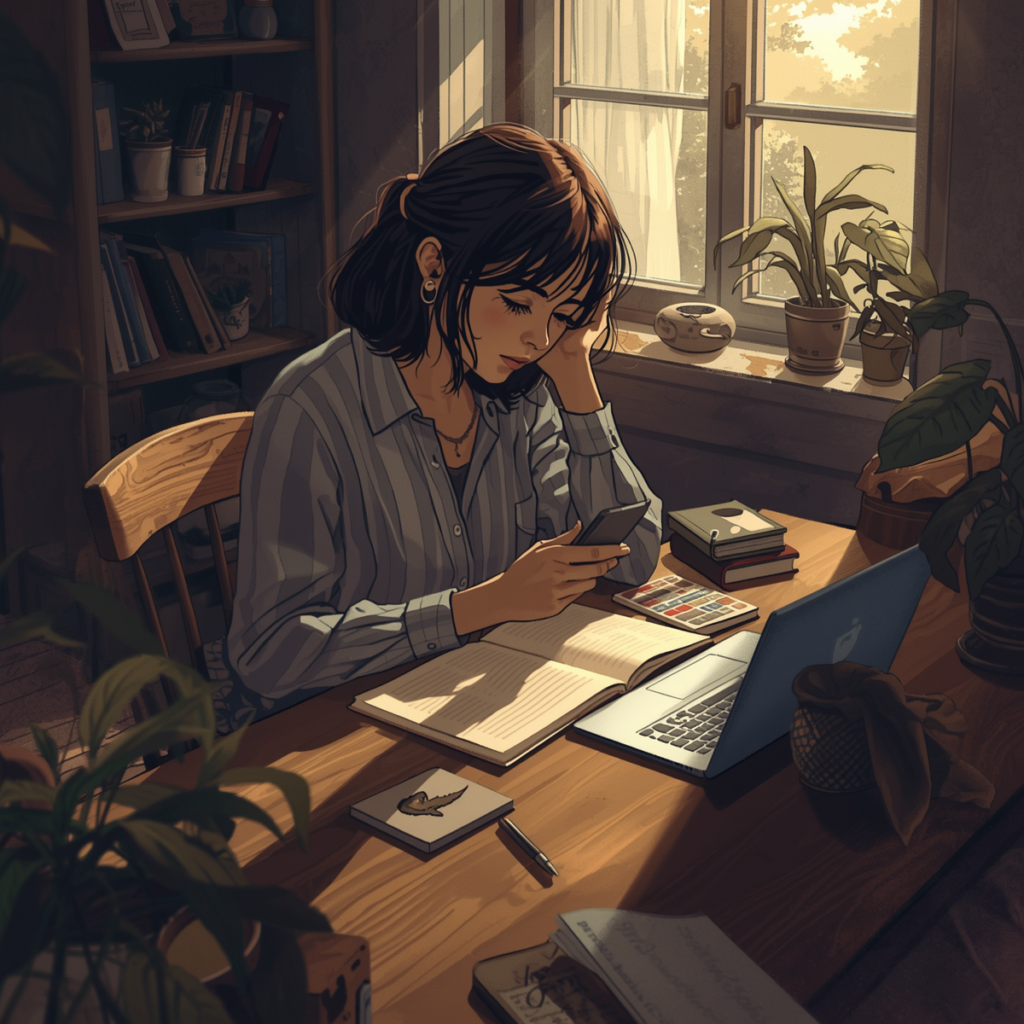
This was the almost daily pattern of my life. But there were a few things at play here which I wasn’t able to identify at the time. I worked better later in the day, from around that 3pm mark, I could start up and keep going. This remains with me, a challenge I still battle through because I have to stop for the frustratingly inconvenient task of making and eating an evening meal for my family and me. Forcing myself to sit and try to work in the mornings was never going to work, I cannot be forced to do anything, especially if there’s no imminent risk of me not doing so. Give me a deadline in two days, and there I’ll be, until the wee hours, hammering away at the keyboard like a woman possessed. I also found that attacking a new assignment was PURE TORTURE. Set me in front of a blank Word document with a set of abstract instructions and I’ll cave within minutes; I’d give up anything under that type of duress. However, trawling through journals to find one obscure piece of evidence to include in my exploration of Beyoncé’s stylistic creativity in her depiction of highly socio-political discourse via popular music can keep me going for days. Misplaced effort, much? Just a tad. That was the content for my undergrad final paper, by the way. Class, I know.
A massive one for me, and one which has definitely worsened since becoming a mother, is noise. I can NOT function properly in the presence of loud or repetitive noises whilst I’m trying to work or concentrate on a task. An example? I once stood, having a conversation with two friends, whilst a child was banging on an outdoor instrument at a playground, repetitively and with the might of a silverback. Mid-sentence, my brain just shut down. I completely forgot what I was saying. They were still able to converse, but my brain went blank. All I could hear, all that I could filter through, was that BANG BANG BANGing. It’s like when you watch those cartoons of someone about to snap, and you see their eye twitching. I physically could not tune my mind back into the conversation and block out the noise, which my friends found amusing. They know me and know I wasn’t being rude or difficult, so it was fine, but it’s flipping frustrating to glitch out mid-conversation. It makes meeting friends in public places a tricky situation to navigate and often results in mindless nodding when someone’s talking, so you appear to be listening.
Sensory overload aside, there’s another monthly visitor that throws everything into disarray, and I’m not just talking about my period.
That week prior to the time of the month, the late luteal phase, can be completely unhinged. If it’s not mood swings from intense rage to feelings of utter despair, then it’s intense brain fog. And I’m talking to the level of forgetting why you even stood up, not just going to another room and being unable to recall what you were going to do there. Or doing a task at the same point in your week, every week, except that week before your period, when you have no recollection of that task whatsoever. That is, until a night or two later, at approximately 2:57am in the morning – tits! I forgot the thing! How do I show my face at work and admit my blunder without coming off as a complete dipstick??
To this day, I’m still in a bit of disbelief over how I’ve managed to achieve a bachelor’s and a master’s degree later in life. I completed a large portion of my undergraduate studies whilst being a stay-at-home mum, but even with a bit more time to complete assignments (without a full-time job), I still required extensions. I worked until the very last minute on every essay, critiquing and perfecting every sentence. It usually came down to starting on them much later than I ought to, meaning I worked at a consistently high level of anxiety. Despite doing well on my undergraduate degree, I would most certainly have done better if I’d given myself more time. And this was more obvious with my master’s. By the time I studied for this, I was back in full-time work, had less time to study, and still got back to my old tricks of leaving studying and writing until the last minute. I even missed one of my assignments altogether. I still passed, but if I’d been able to work to my potential, I’d have no doubt that I would have achieved another distinction. Cue the shame and disappointment.
These days, as cheesy as it sounds, I try to be gentler with myself. I’ve grown to like parts of my ADHD, the things that make me unique. It’s still frustrating as hell, but I know, even with the best intentions, I’m going to f up. I use calendar reminders, planners, whiteboards, and to-do lists; they’re not going to stop me from forgetting things, but so long as I keep up the habit of utilising them, I can get by ok. I have good days and bad days, usually dictated by my cycle. I tend to use up all my organisational skills during my working day, to the point where a lot of people over the years have thought I’m a super-organised person, but sadly, my personal-life organisation is then somewhat lacking because I’ve squandered all of that energy by the time I get home. I find habit-stacking a super useful tool when I can figure out how to slot new things in and make them stick. These days, being praised for potential often comes with my writing ideas. I can come up with some belters, ones I’m super excited about and that pique genuine interest in those I tell them to, but then someone might say
‘How’s the writing going?’
‘How’s the book coming along?’
‘Did you write that thing you told me about?’
And the shame sinks its claws in once more. Especially when partnered with a jovial comment along the lines of ‘come on, you’ve got a talent for writing, get it done!’.
Get it done! Why hadn’t I thought of that?
Leave a Reply